

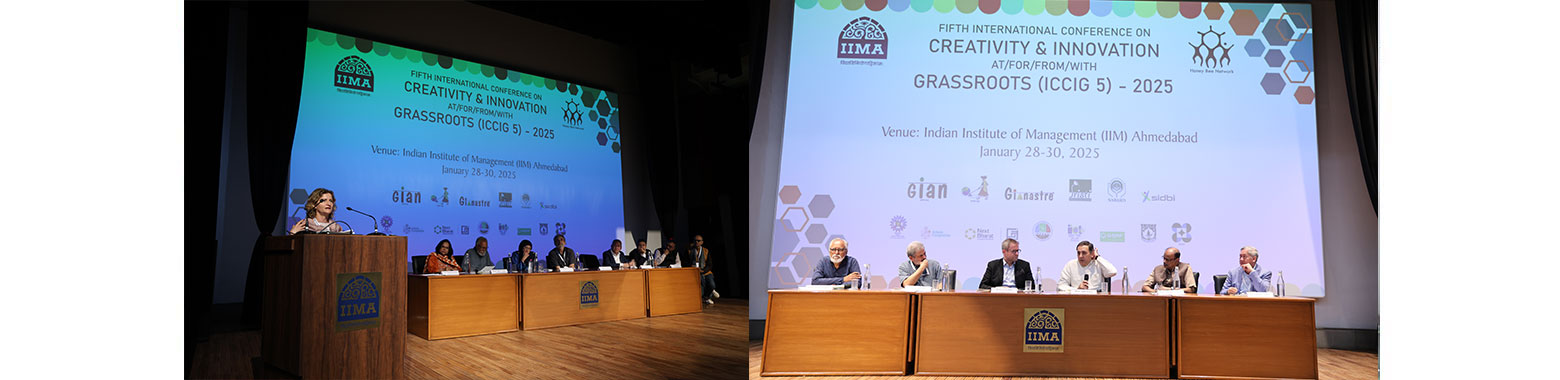
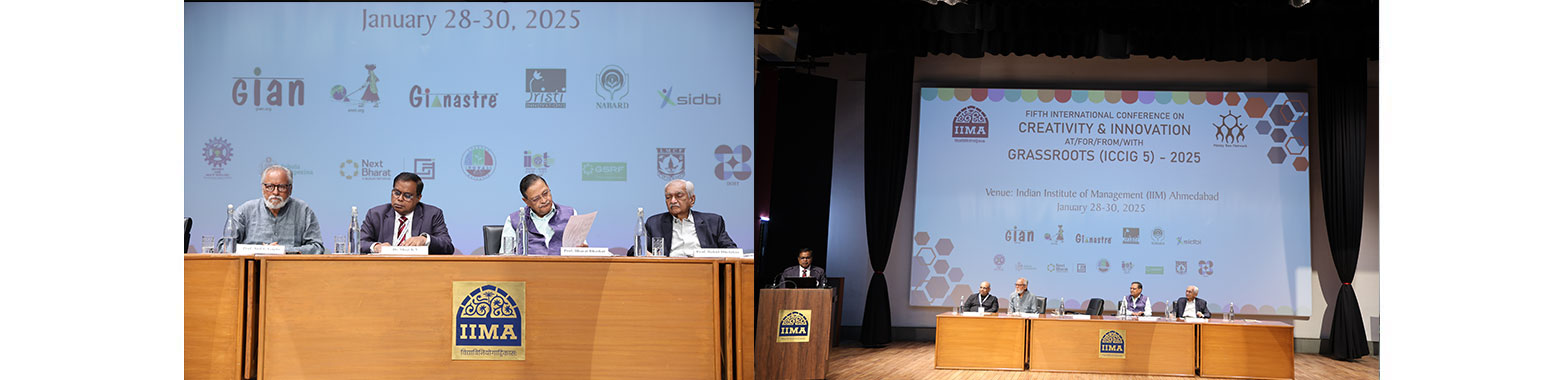
International Conference on Creativity and Innovation at Grassroots - ICCIG 5
Bringing policy makers, scientists, researchers, grassroots innovators, creative artists, innovative teachers, students, civil society organizations and others on a common platform has been the most distinguishing feature of the International Conference on Creativity and Innovation at Grassroots since 1997. There are several insights and institutional initiatives that have emerged from previous ICCIGs.
First ICCIG, 1997, led to the establishment of GIAN (Gujarat grassroots Innovation Augmentation Network) with the help of Gujarat government, Honey Bee Network, SRISTI and IIMA. Purpose was to articulate the golden triangle linking innovator, investor and entrepreneur by reducing the transaction costs of each actor. It has tried to help provide handholding support to the innovators at their door step. The model of GIAN was scaled up into NIF which is now a part of government, and I have stepped down from all responsibilities in the matter.
GIAN also helps organize People’s Festival of Innovations every year at IIC New Delhi in cooperation with C-Camp. It provides HBN Creativity and Inclusive Innovation Awards both at national and international level. SRISTI anchors the Gandhian Young Technological Innovation Award (GYTI award), Dr A P J Abdul Kalam ignited mind children creativity and innovation award supported by GIAN and other Honey Bee Network volunteers. It also coordinates Shodhyatras in different parts of the country along with GIAN and HBN.
The inclusive innovation movement highlighting frugal innovations for and from grassroots has spread all over the world thanks to the volunteers of HBN. In the second ICCIG in 2012, it was realized that heuristics of frugal innovations can be used by even large organizations. This is evident from many international companies trying to learn from HBN experience. It was proposed that there should be an international repository and registry of grassroots innovations and outstanding Traditional knowledge. Why should people disclose their knowledge if we cannot provide them any formal acknowledgement and minimal protection. Way back in 1993, it was proposed to set up INSTAR (International Network of Sustainable Technological Applications and Registration) as a global registry- a goal still to be achieved. In the third ICCIG, 2015 there were many ideas stressed such as focus on finding science underlying farmers’ practices, creating FabLab network and creating mobile FabLab for helping grassroots innovators for short duration fabrication. It was also suggested that in various scientific meetings on agricultural, industrial or medical science etc., a session on people’s knowledge may be organized so that scientists get exposure to a rich knowledge system still vibrant at community level and hopefully blend it with high tech science and technology opportunities to serve the society.
The fourth ICCIG reinforced the above ideas but also suggested a few more proposals to implement HBN philosophy of giving voice, visibility and velocity to grassroots creativity and innovations. There are agricultural research and extension centers in every district in the form of KVKs (Krishi Vigyan Kendra) also District Industries centers. But these have not become a platform for showcasing, trial, validation and value addition in grassroots innovations and outstanding TK. Another that picked up momentum in fifth ICCIG also was a need for all India (later, an international) Coordinated Action Research Project on Validation, value addition, Dissemination of Grassroots Innovations. Most international agricultural research centers have also not yet created a dedicated mechanism for cross-pollination of bottom up solution by grassroots communities. Can all Members of Parliament and State Assemblies use pert of constituency development funds for encouraging creative and innovative people in technology, education, institutions, biodiversity and natural resource conservation and cultural.
UNDP through its wide network of Acc Labs in 115 countries did make a very bold attempt to triggers solution mapping at grassroots level and mapped more than 3500 innovations from all over the world. HBN and GIAN contributed to building capacity of 91 labs in these countries. Can this be done in a more enduring manner through Global Inclusive Innovation Foundation (GIIF) or Academy of Inclusive Innovation and Knowledge Augmentation (AIIKA) is a question that was discussed in the open house at fifth ICCIG. Several other suggestions have come up in the fifth ICCIG, only some of which are reflected in the abstracts.
Agro-ecological and social-ecological models of connecting natural, social, ethical and intellectual capital will need to be developed.
Unlike traditional B2B (Business-to-Business) or B2C (Business-to-Consumer) models, which prioritize sale by large corporations and established brands to local businesses and communities, g2G (grassroots to global) tries to if not reverse, counter-balance the pressures of globalization and reaches the grassroots communities in developed countries as well.
The g2G model rests on the assumption that with economic pressures tightening worldwide and markets becoming more competitive, customers worldwide are actively seeking ultra-frugal solutions. The g2G offers a double-edged sword—on one hand, it helps cut poverty in these regions by fostering local businesses, and on the other, it delivers affordable solutions to global consumers. Affordability must extend beyond consumers and manufacturing, it must also apply to the environment.
Similarly, the need for risk fund, support from Research and development agencies, marketing and supply chain support need to be provided to the grassroots innovators. There is also a need for a Bank of Unmet Needs in multiple sectors and stages which can trigger the experiments by youth and others in academic and field situations to meet them.
The support from NABARD has been very crucial to accomplish many goals of the fifth ICCIG and facilitate the participation of farmers, self-help groups and other innovators in the conference. The inaugural address by Shri Shaji K V, Chairman, NABARD, added so much energy and hope among the creative participants for many more impactful changes at grassroots level in the years to come.
HBN also appreciates the message of goodwill sent by Shri Bhupendra Patel, Chief Minister, Gujarat government and address by State minister of Small and Medium Industries, Cottage, Khadi and Rural Industries, Civil Aviation, Government of Gujarat Shri Jagdish Vishwakarma, at the plenary session of ICCIG. The support from the Industry department has always been a source of special strength for GIAN and HBN.
Grateful thanks are due to Prof Bakul Dholakia, Chairperson, GIAN board and former Director, IIMA for support and guidance all through the preparation of the conference. We thank all the Board members for their continued support in all endeavors of GIAN.
I am very happy to acknowledge the extraordinary support from Centre for Management in Agriculture and various other departments/areas/centers of the Indian Institute of Management, Ahmedabad, without which the fifth ICCIG could not have been such a success. We must particularly thank Prof Bharat Bhasker, Director, IIMA and all other Deans and Administrative heads for unstinted support for hosting fifth ICCIG at IIMA. Prof Ranjan Ghosh, Chairman, Centre for Management in Agriculture, IIMA, co-organiser of ICCIG deserves my personal appreciation for such a warm cooperation and support for the conference.
I must acknowledge the support of prof Vijaya Sherry Chand who helped in reviewing a very large number of abstracts and papers besides addressing the conference on the theme of Educational Innovations. He and FAIR-E also helped us in mobilizing a large representation of Innovative teachers from government schools.
We have to appreciate a very meaningful dance performance by the students of Dr Kalam Innovative School brought a exposure to the cultural diversity of our country.
The volunteers and team members of SRISTI like Chetan Patel, Ramesh Patel, Bhoomi, Sumitra, Alka, Mayur, Ankit, Swasti Dhagat, Zinkal, and numerous others worked day and night to make the conference so meaningful.
The GIAN team led by Dr Anamika Dey, Academic coordinator of fifth ICCIG collaborated with CMA Chair prof Ranjan Ghosh, Manager CMA, Uma Baskaran, Astt Manager, Dipali Chauhan, Audio-visual section, internet and communications, public relations office, and SRISTI team for many months in advance to make the conference possible. GIAN team including Ankit, Kishor, Rageshri, Intikhab, Ravi, Aneeta, Sapna, Deepika, Akshay, Faraz, Dhyanesh, Nadeem, Sabzar, Abhijit, Dorji, Sanjay, Bharat, Mukesh, Ramesh, Praveen, Mehak, Sugandha, Krutik, Unnikrishnan, and many others spared no effort to make the ICCIG a memorable conference for grassroots innovators, scholars, and others.
GIAN also thanks, SIDBI, Next Bharat, Malaysian Innovation Foundation (YIM), CSIR-IICT, ISTIC, Malaysia, LM college of Pharmacy, DOST/GRIND, Philippines, SRISTI Innovations, GIANSTRE, Gharda Chemicals, Schola Campesina etc., for their invaluable support and contribution to the Conference.
I must acknowledge all collaborators of Honey Bee Network including Brig (Retd.) Ganesham Pogula, P Vivekanandan, Sunda Ram verma, Balaram Sahu, Tshering Gyasto Lepcha and numerous others scholars, innovators and policy makers form India and abroad whose contribution made the conference meaningful. International participation from 23 countries enriched the conference immensely. The grateful thanks are due to Grassroots Innovations Assembly for Agro-ecology (GIAA) which brought the largest contingent to the conference.
I will like to specially thank Prashant, Kiran Thete, Sandeep and numerous other research staff/fellows and about fifteen doctoral students of IIMA who did a great job of keeping track of what was discussed in each of the session.
A conference at this scale is a collective task of so many, some may have remained unnamed. But I thank them all for enriching our collective understanding of what knowledge rich, economically poor innovators can do to make our society more creative, collaborative and compassionate.