

Recent news
A portal for young technological brilliance
Recent NewsPublish in mailtoday.in on 11, Feb, 2010
AFTER bringing innumerable grassroots innovations to light, the innovation guru from the Indian Institute of Management Ahmedabad, Anil K Gupta, has begun mapping young minds in our engineering colleges. At any given time, India has about six lakh engineering students who spend six months in their final year on a project, which is supposed to be on a problem of relevance to industry or society. But nobody knows what happens to these projects once they are completed.
Innovator network plans giant leap on the back of 3 Idiots
Recent NewsThe inventions were sourced from the National Innovation Foundation, set up nine years ago by the Indian government with inspiration and support from a 16-year-old proponent of grass-roots invention, the Honey Bee Network
For More Details Click Here
Flavour of India at Sattvik 2009
Recent NewsPublish in Times of India on 20/12/2009
AHMEDABAD: Relish the sweet aroma of saffron-flavoured green tea, Jafrani Kahwa from Jammu & Kashmir, garnished with almonds and pistachios to bamboo soup delicacy, a speciality of Arunachal Pradesh (AP).
Both insurgent infested states are showcasing their rich cuisine, traditional food items and products during the three-day Sattvik 2009', traditional food festival organised by SRISTI and Indian Institute of Management-Ahmedabad (IIM-A) which kicked-off on Saturday.
Fayaz Ahmed from Anantnag, Jammu & Kashmir said, "Jafrani Kahwa is made in Kashmiri Samovar, a traditional kettle, a large decorated urn with burning coals underneath. Kahwa is prepared using different kind of ingredients like saffron, almond, Cinnamon and cardamom."
"Kashmiri cuisine has lot to offer amdavadis but this time we have limited items here," adds Ahmed. Another, insurgent state, Arunachal Pradesh in news for its confrontation with China has displayed a rich variety of traditional food products like Onger, Iyup (Bamboo soup), Dikang (a natural hair conditioner) and organic oranges.
Jatin Tayang from East Siang, AP says, "This is for the first time we are coming here and it has been an overwhelming support. We are very much part of India and north eastern states has lot to offer to people here."
"The bamboo soup is made up of bamboo buds and it can be mixed with pulses, it gives a tangy taste like lemon," adds he.
Upbeat about the success of festival, faculty, IIM-A, Prof Anil Gupta says, "The festival shows the rich bio-diversity existing in rural areas of the country untouched by the urban masses. This time we have representatives even from insurgent states like J&K and AP which are offering state delicacies, it will also create sensitivity about these states."
At more than 50 stalls organic foods, food grains, fruits and traditional delicacies and rural innovations are at display.
IN BOX :
The food stall run by HIV positive people of Adhaar Mahila Trust and Saral offering Bajare ki roti, soybean cutlets among others have been hit among the visitors. The organisation have been preparing snacks as part of the Food Reach Programme, funded by World Bank
Hemali Leuva of the organisation says, "The programme is to reduce stigma & discrimination of HIV positive people and this initiate has been well accepted by the visitors."
Machine that can take orders to cook meal
Recent Newswishful thinking a reality.
Meet Abhishek Bhagat, a class XII student of Bhagalpur’s Aryabhatt Public School who has designed a prototype of a gadget which makes dishes. Christened `Kitchen King’, the gadget is powered by electricity and has a capacity to prepare dishes that require a maximum of 12 ingredients.
President Patil for grassroot level innovations to tackle climate change
Recent NewsPTI
Wednesday, November 18, 2009 17:19 IST
DNA
New Delhi: With the world's attention focused on the outcome of the Copenhagen summit, innovators at the grassroot level can help provide answers to climate change, president Pratibha Patil said today.
You may also want to see
- Pollution norms to be on a par with Europe
- Climate change deal must aim to help women: UN
- Copenhagen capers
- 'Like US, govt denies climate change'
- Binding climate treaty may slip far into 2010
"World attention is focused on the outcome of the Copenhagen conference. I think our grassroot local innovations can be useful not only for national problems but also for world problems and answers for our second Green Revolution and climate change," Patil said.
Dr Abdul Kalam Chief Guest at Nirma University convocation
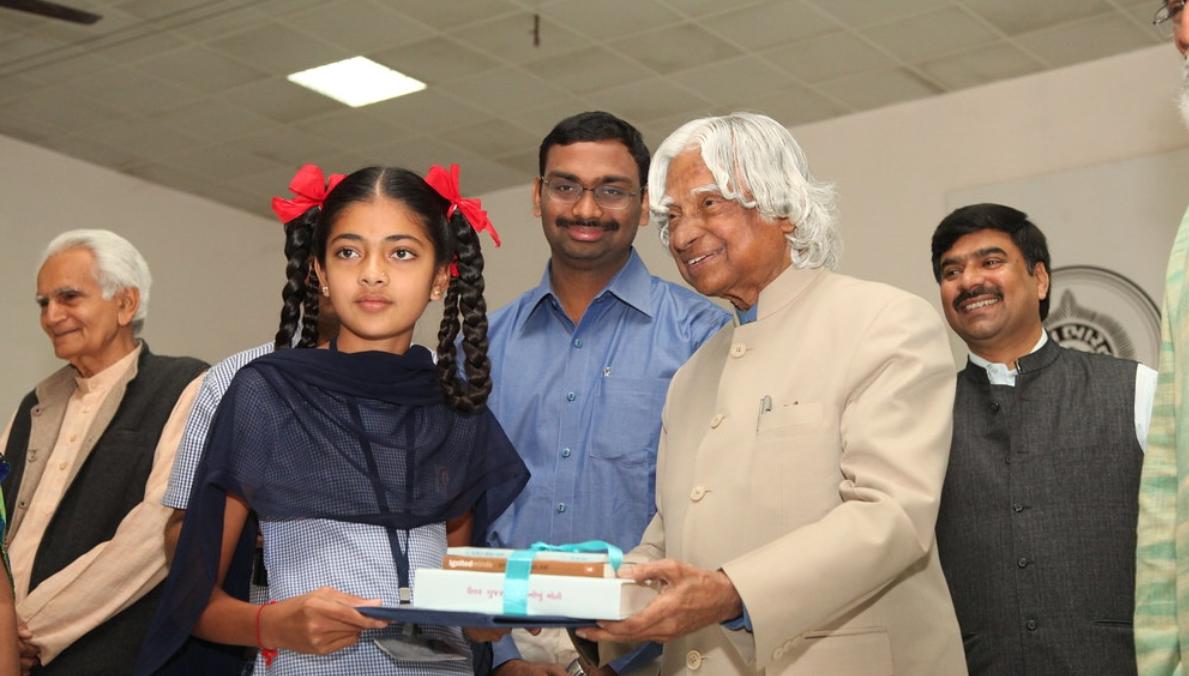
Recent NewsFormer President Dr A P J Abdul Kalam was the chief guest at Nirma University’s eighth convocation ceremony on Monday.
Diplomas and doctorates were conferred on 1,251 students — including 61 gold medals, awarded to 48 students in various disciplines.
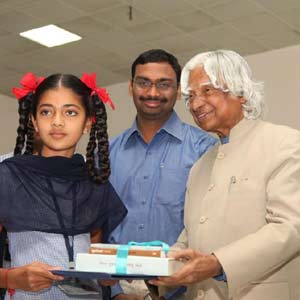
Kalam is in the city to deliver lectures at the Indian Institute of Management—Ahmedabad for the GRIIT (Globalising Resurgent India through Innovative Transformation) course that he teaches along with Professor Anil K Gupta.
Log On To The Power Of Ideas
Recent NewsPublish in Times of India on 9th August, 2009
"The next 10 years would be dedicated as a decade of innovation" were the words used by the president of India to conclude her address to Parliament on June 4. On June 7, US president Barack Obama, in his Cairo address, said: "Education and innovation will be the currency of the 21st century." Between June 3 and 5, the first Global Innovation Leaders' Summit (I-20), fashioned on G-20, was held in San Francisco. I was invited to represent India. I-20 accepted Norway's suggestion of introducing a Nobel Prize for innovation. So from Delhi to Cairo to San Francisco, the 'buzz' was around innovation. Click Here
Department of Scientific and Industrial Research (DSIR) Technopreneur Promotion Programme (TePP) Invitation for proposals 2009-2010
Recent NewsFor More Details : Click Here
Let talent blossom
Recent NewsPublish in Indiatoday on 17/7/2009
Bavabhai Sondarva, a teacher from Junagadh, asked his students to collect different thorns from different corners of the village. He then explained to them the conditions these thorns required to survive in. A simple approach like this that deviates from the prescribed format of teaching only from the textbooks can drive the point home sooner.
For more Details Click Here
A snip at the price
Recent NewsThe Economist print edition on 28 May, 2009
The recession gives parsimonious innovators a chance to go global
COBBLED together from carts, old cars and anything else to hand, the improvised vehicles used by Indian farmers are often known as jugaad. The term also has a much broader meaning—referring to an innovative, low-cost way of doing something—as goods and services are provided in India at a fraction of the cost of those in developed countries. Ingenuity is a necessity when resources are limited and customers have little money. In a global recession it also provides a way for companies in India and China to expand into foreign markets where consumers are seeking better value for money.
Asia’s cost-cutting innovators reject the notion that purchases of certain items only take off when consumers’ incomes reach specific levels, says Rama Bijapurkar, a consultant, speaking at a recent conference organised by the Centre for India and Global Business at the Judge Business School in Cambridge, England. Instead of selling items in small quantities to the rich while waiting for everyone else to pass the relevant “income threshold”, they re-engineer their products into cheaper ones to unlock mass markets right away.
Anil Gupta, of the Indian Institute of Management, helps run the Honey Bee Network, which encourages grassroots innovation in a number of countries. The projects he has been involved with include a refrigerator built from clay, which uses no electricity yet can help keep vegetables fresh for several days, and a cheap crop-duster in the form of a sprayer mounted on a motorcycle.
Innovation also takes place at a higher level, especially in the growing number of sophisticated research-and-development (R&D) laboratories in China and India. China is already close to overtaking Japan in research spending: over 300 multinationals have opened R&D centres in the country, says Peter Williamson, visiting professor of international management at the Judge school. Many firms began by using Chinese engineers and scientists, who are paid about a quarter as much as those in Europe or America, to adapt products for the local market. But now, he says, they are developing products for world markets.
Alamy

Watch out, Ferrari
There are also home-grown innovators such as BYD, a Chinese electronics firm. It has developed lithium-ion batteries that are unusually cheap and easy to make. It has succeeded in reducing costs from $40 a battery to less than $12. Earlier this year BYD’s automotive subsidiary unveiled a plug-in electric-hybrid car at the Detroit motor show. Thanks to the firm’s cheap batteries, it could sell for about half the $40,000 or so that the Chevy Volt, a plug-in hybrid under development at General Motors, is expected to cost.
Other examples in China include ZPMC and Zhongxing Medical, says Mr Williamson. ZPMC hired a small army of 800 design engineers to produce container-management systems which it customises for individual ports. It has now captured half the world market in harbour cranes. Zhongxing Medical, borrowing technology from the aerospace industry, has produced an X-ray machine capable of producing digital images directly. Although not as sophisticated as some fancier models sold by Western firms, it is suitable for most routine applications, such as chest X-rays. And it is produced for almost a tenth of what GE and Phillips used to charge for specialised digital X-ray machines, even after those companies cut their prices.
Perhaps the most famous cost-cutting innovator in Asia is Tata Motors, India’s biggest carmaker. In March it launched the Nano, which in basic form costs 100,000 rupees ($2,100). A fancier version of the car is expected to be launched in Europe and America in about two years.
India’s prolific and low-cost film industry, which churns out some 12,000 movies a year, is also going global. Although Indian films have long had a foreign audience, new co-production deals with Hollywood should increase their reach. Reliance Entertainment, for example, signed a deal with a number of American production houses last year. Rohan Sippy, a Bollywood producer, told the conference that Hollywood studios are keen to do deals with Indian filmmakers so that they can make for themselves cheap song-and-dance “masala” versions of American movies before Indian studios beat them to it. Whether Western firms can truly learn the ways of the jugaad, however, remains to be seen.